Have you ever sat down to work, looked at your to-do list, and then somehow spent the next hour doing everything except the thing you planned to do?
Maybe you checked your email, organized a few files, watched a YouTube video that counted as “research,” or convinced yourself you should do just a little more planning before getting started. I’ve been there more times than I’d like to admit.
And every time it happened, I’d tell myself I’d do better tomorrow. Tomorrow I’d finally be more focused. Tomorrow I’d stop procrastinating.
That’s why for a long time, I assumed the problem was me. If my business felt difficult, I figured I simply needed more discipline, more motivation, better time management, or another productivity system. Surely if I could just become a little more productive, everything else would fall into place.
If you’ve ever felt that way too, you’re definitely not alone.
Most of us have been taught that when business feels hard, the solution is obvious:
Work harder.
Put in more hours.
Stay more consistent.
Learn another strategy.
Don’t get me wrong. Sometimes those things really do help.
But over the years, I’ve started to notice something. A lot of the work in our businesses isn’t difficult because we’re doing it wrong. It’s difficult because we’ve accidentally designed it to be harder than it needs to be.
That realization completely changed how I look at my business. Instead of asking, “How do I make myself do this?“, I usually start with a different question:
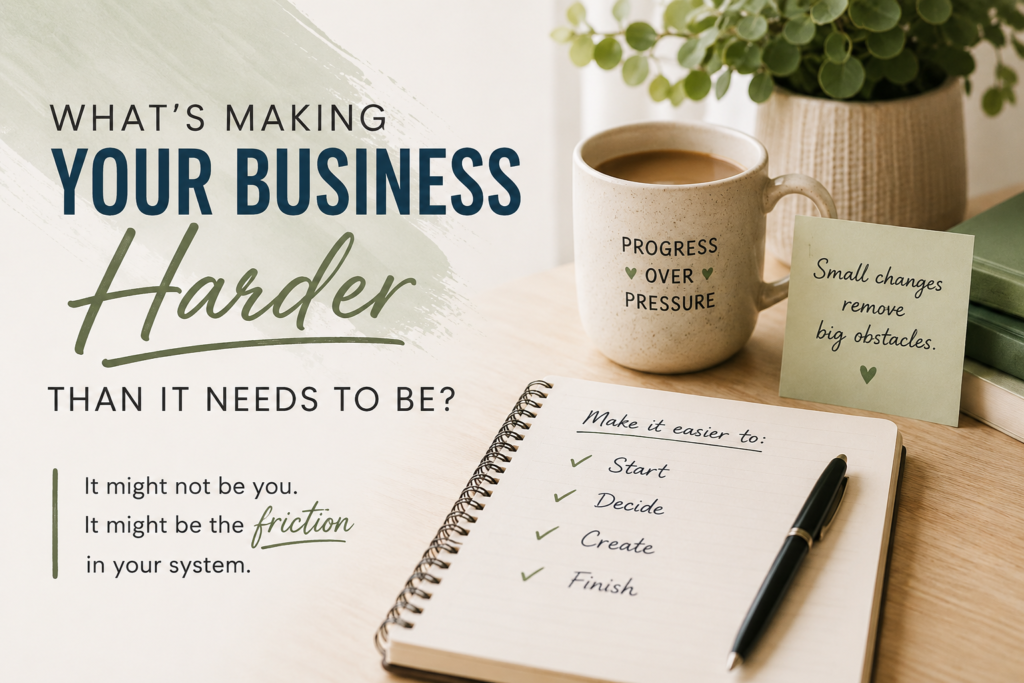
What’s making this harder than it needs to be?
We Blame Ourselves Before We Look at the System
Imagine you’ve been putting off writing your weekly email.
The obvious conclusion is that you’re procrastinating. Maybe you promise yourself you’ll finally become more consistent next week, or tell yourself you’ll catch up once life slows down.
But what if that’s not the real problem?
What if every email feels like it has to be amazing before you can send it? What if you haven’t decided what you’re going to write about yet? What if writing one email actually requires opening five different programs, hunting down notes, checking links, finding graphics, and making a dozen little decisions before you ever type the first sentence?
By the time you’ve done all of that, your brain is already exhausted and ready to be done with the task.
That’s not a motivation problem.
That’s friction.
Friction has a sneaky way of making us think we’re lazy when we’re really just making the work more complicated than it needs to be.
Tiny obstacles have a way of pretending they’re personality flaws.
We don’t notice the extra decisions, the scattered files, or the missing systems. We just assume we’re the problem.
Tiny Frictions Become Big Problems
One thing I’ve learned is that we tend to notice the big obstacles while overlooking the tiny ones. But those tiny obstacles quietly pile up until they change how the work feels.
An extra decision here. A missing template there. Files scattered across different folders. Trying to make five decisions before you can make the first one.
None of those things seem like a big deal individually. Together, though, they create just enough resistance that your brain starts looking for something easier to do.
That’s why you’ll check your email instead of creating content, organize your desktop instead of launching your product, or research another strategy instead of sending the sales page you’ve already written. Not because those things are more important, but because they have less friction.
What This Looked Like in My Business
One thing that always confused me was writing. I actually love writing, so it never made sense that I kept putting off writing blog posts.
Every time I opened my laptop, I’d ask myself, “What should I write today?” Sometimes I’d have twenty ideas competing for my attention. Other days my mind would go completely blank. Oddly enough, both situations led to the same result.
I didn’t write.
Either way, I’d end up spending twenty or thirty minutes trying to choose the “right” topic instead of actually writing.
I’d wonder which idea would help people the most. Then I’d pick one, and convince myself I should save it for later so I could do it “right.” Before long, I’d be debating whether something should become a blog post, an email, or a YouTube video.
Ironically, I was spending more time deciding what to write than actually writing. By the time I finally settled on an idea, I didn’t feel like writing anymore.
For a while, I assumed I needed to be more disciplined. Maybe I wasn’t “in the mood” to write, and that’s why I wasn’t getting it done. Maybe I needed to push myself harder. I didn’t know why. I just knew I wasn’t accomplishing something I genuinely wanted to do.
Eventually I realized something.
I wasn’t avoiding writing. I was avoiding making a difficult decision.
Once I saw that, the solution became surprisingly simple. Instead of deciding what to write every time I sat down at my computer, I started keeping a running list of ideas. Whenever something came to mind, I’d add it to the list.
Now, when I want to write, the hardest decision has already been made. Everything after that becomes easier. I can’t begin to tell you how much difference that one change has made.
Now when I sit down to write, I actually write!
Since then, I’ve started noticing this pattern everywhere in my business…not just with writing, but with creating products, recording videos, planning projects, and even deciding what to work on next.
The Question That Changed My Business
These days, whenever I find myself avoiding something, I don’t immediately assume I need more willpower. Instead, I get curious.
I ask questions like:
What’s making this feel heavy?
Where am I getting stuck?
Is there an unnecessary decision here?
Could I make the first step smaller?
What would make this easier to start tomorrow?
Sometimes the answer is surprisingly simple.
Such as:
I need a checklist.
I need a template.
I need to stop trying to finish the whole project in one sitting.
I need to make one decision today so Future Me doesn’t have to make it again next week.
Those changes don’t sound exciting. They’re rarely the kind of thing people make YouTube videos about. But they’re often the changes that make the biggest difference because they remove friction instead of demanding more discipline.
Progress Doesn’t Always Come From Doing More
That experience taught me something I now look for everywhere in my business.
Sometimes the work isn’t hard. The decisions before the work are what’s hard.
Once you start looking through that lens, you begin to notice friction everywhere. Sometimes it’s an unnecessary decision. Sometimes it’s a missing system. Sometimes it’s simply that you’ve made the first step harder than it needs to be.
When something feels difficult, the answer isn’t always to work harder. Sometimes the answer is to redesign the work instead. Make it easier to begin. Reduce the number of decisions. Move related tasks closer together. Create a repeatable process. Remove one unnecessary step.
None of those ideas make flashy headlines, but they’re often the changes that make the biggest difference because they remove friction instead of demanding more discipline.
When your business becomes easier to run, something interesting happens. You stop relying on motivation. You stop waiting until you “feel like it.” You simply find yourself doing the work more often because there’s less standing in your way.
Try This Today
Think about one task you’ve been avoiding. Not the biggest one, just one that keeps getting pushed to tomorrow.
Before you tell yourself to try harder, ask yourself this instead:
What’s making this harder than it needs to be?
Write down every tiny annoyance you can think of. Every extra click, every unnecessary decision, every place where the work feels heavier than it should.
Then improve just one of them. Not everything. Just one.
The next time you catch yourself thinking, “Why can’t I just get myself to do this?” pause for a moment. Maybe the answer isn’t more discipline. Maybe your business is simply harder than it needs to be. And maybe one small redesign is all it takes to change that.
Because sometimes changing your business starts with changing one small part of the system.
