
 Running a business involves a ridiculous number of decisions.
Some of them matter. What should I sell? Who am I trying to help? Is this product worth creating? Why aren’t people buying? Where should I focus my attention next?
But then there are all the little decisions. Should I send an email today? What should I write about? Where did I save that affiliate link? What do I need to do before I publish this blog post? Which social platform should I post this on? What am I supposed to work on first?
None of those decisions seems particularly difficult on its own. But when you make enough of them, they start using up a surprising amount of your attention.
I’ve noticed this especially on days when I’m tired. I can sit down with an hour to work and somehow spend the first 15 minutes deciding what to do. Then I finally choose something…and immediately have another decision to make. And another.
Sometimes the problem isn’t that I don’t have enough time. It’s that I’m using too much of the time I have making decisions I’ve already made before.
Some Decisions Don’t Need to Be Made Again
Take the emails I send my list. I usually do it on Monday, Wednesday, and Friday. I also usually choose one main idea for the week and build my emails around it. Those are two decisions I don’t have to make every time I sit down to write.
I don’t have to ask myself whether I should email today. I don’t have to stare at a blank screen and choose from every possible business topic I could talk about. I’ve already narrowed things down.
Of course, that doesn’t mean the email writes itself. I still have to decide what I actually want to say. I have to choose examples. I have to decide whether there’s something that makes sense to promote.
But those are decisions that actually deserve my attention. Whether Wednesday is an email day probably doesn’t.
That’s one of the things I’ve come to appreciate about simple systems. A good system makes some decisions once so I don’t have to keep making them.
Look for the Decisions You Keep Repeating
There are probably decisions in your business that you’ve made dozens of times.
Maybe every time you publish a blog post, you have to remember what happens next. Add the featured image. Write the meta description. Check the links. Add the category and tags. Share the post. Send the email.
If you have to remember all of that from scratch every time, publishing requires more mental effort than it needs to. A simple checklist changes that.
The checklist doesn’t do the work for you. It just eliminates the decision about what happens next.
The same thing can happen with content. Maybe every week you sit down and ask:
What should I talk about this week?
You could keep making that decision from scratch. Or you could keep a running list of ideas as you have them.
Now when it’s time to create something, you’re not starting with the entire universe of possible topics. You’re choosing from ideas you’ve already captured.
That’s a tiny system. But tiny systems can remove a surprising amount of friction.
Systems Can Protect Your Attention
I think this is the part of systems that gets overlooked. We usually talk about systems as a way to save time or become more productive. And they can absolutely do that.
But I also think they protect something else that’s valuable:
Your attention.
If I’ve already decided how I normally do something, I don’t have to use my attention deciding it again. That matters because I have a limited amount of attention to give my business.
I’d rather use it figuring out why an offer isn’t selling than trying to remember what I normally do after publishing a blog post. I’d rather use it deciding which product deserves my attention than deciding for the hundredth time where I keep my affiliate links.
I’d rather use it thinking about what my customers actually need than wondering what I’m supposed to work on next.
The goal isn’t to eliminate decisions from your business. It’s to eliminate the ones that don’t need to keep being decisions.
But I Don’t Want My Business to Feel Rigid
This is where I used to get stuck. When I thought about creating systems, they sounded so…rigid.
Every Monday I do this. Every product has these exact steps. Every email follows this formula.
But that’s not how I want my systems to work.
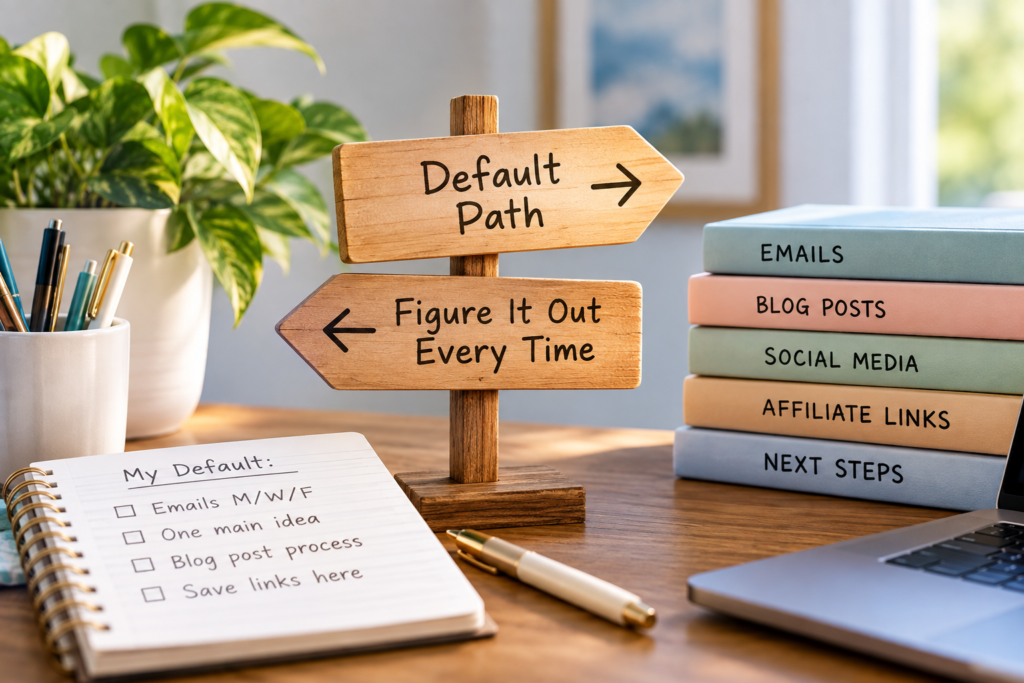
I don’t need a rule. I need a default.
There’s a big difference. A default says: This is the way I normally do this unless I have a reason to do something different.
I normally email Monday, Wednesday, and Friday. But if Monday is a holiday, I can send it on Tuesday. I normally build a week’s emails around one main idea. But if something happens that I really want to tell you about, I can change the plan.
I can have a checklist for publishing a blog post and change that checklist when I realize one of the steps no longer makes sense. The system isn’t in charge of me.
It’s there to make things easier for me.
A Good System Should Be Easy to Change
I think that’s an important test. If a system becomes so complicated that you’re afraid to change it, it might not be helping as much as you think.
The systems I find most useful are usually pretty simple. A checklist. A template. A recurring calendar reminder. A folder where something always gets saved. A running list of ideas. A default day for doing something.
Nothing particularly impressive. But that’s part of why they work.
I can use them without thinking very hard about them, and I can change them when my business changes. A system doesn’t have to be permanent to be useful.
It just has to make the way I’m working right now a little easier.
Where Are You Starting From Zero?
If you want to find opportunities for simple systems in your own business, I’d start with one question:
What am I deciding over and over again?
It could be deciding what to post on social media or trying to remember the steps you take every time you get a new client. It could be hunting through old emails for your affiliate links every time you want to promote something. Or it could be sitting down to work and spending the first 15 minutes deciding which project deserves your attention.
Pay attention to those moments. You don’t necessarily need a complicated automation or an expensive piece of software. Sometimes you just need to make one decision once.
Create the checklist. Choose the default. Save the link somewhere obvious. Write down the process. Make the running list.
Then the next time you get there, you don’t have to start from zero.
Save Your Decisions for the Things That Actually Need Them
There will always be plenty of decisions to make in a business. I don’t think the goal should be to systematize every minute of the day or remove every choice.
Some decisions should be made fresh. Your business changes. Your customers change. Your priorities change. You learn things you didn’t know before.
Those decisions deserve your attention.
But whether you should do Step 3 after Step 2 for the hundredth time? Maybe not.
So when you notice yourself making the same decision again, stop for a second and ask:
Does this actually need to be a decision every time?
If it does, make it. If it doesn’t, maybe it needs a simple system instead.
Because the fewer times you have to reinvent the things you’ve already figured out, the more attention you have for the parts of your business that actually need you.
