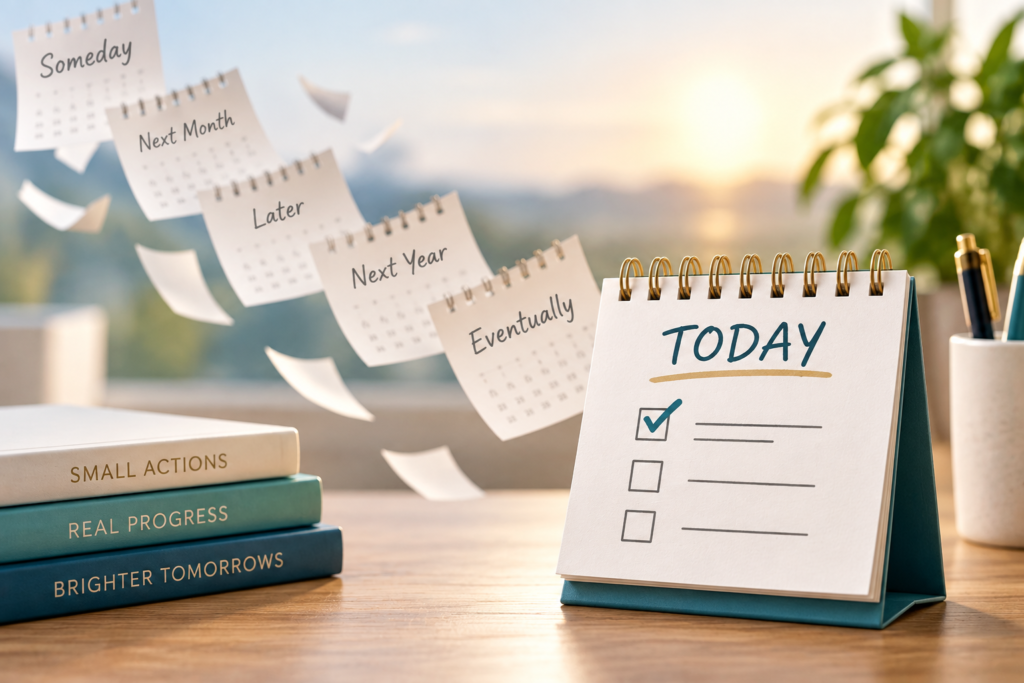
 There are a lot of things I’ve been planning to do in my business when I have more time.
I’ll start making videos again when I have more time. I’ll build that new funnel when I have more time. I’ll go through some of my older products and improve them when I have more time.
And I genuinely believe myself every time I say it.
The problem is that I’m not entirely sure when this magical “more time” is going to arrive.
There always seems to be something else that needs to be done. And even when I suddenly have a little more time, somehow I manage to find enough things to fill it.
Meanwhile, some of the things that could actually help my business grow keep getting pushed to another week, another month, or apparently another year.
I still have “create podcast” on my list, and it’s been there for years.
So I’ve been wondering whether I’m asking the wrong question.
Instead of asking:
When will I have time to do this?
I’m trying to ask:
What could this look like with the time I already have?
Those two questions lead to very different answers.
Stop Building Plans Around Time You Don’t Have
Let’s say I decide I want to start making YouTube videos.
In my head, I might picture the whole process. Choose a topic. Research it. Outline the video. Set everything up. Record it. Edit it. Make a thumbnail. Write the description. Upload it. Promote it.
Suddenly “make a YouTube video” feels like something that requires a huge uninterrupted block of time.
I don’t have that today. Maybe next week? Except next week has its own list of things that need to happen.
So instead of making a video that isn’t quite what I pictured, I make no video at all. That’s the part I’m trying to change.
Because if my plan requires three uninterrupted hours every week and I rarely have three uninterrupted hours, I can keep trying to find those hours.
Or I can change the plan. Maybe I make a simpler video. Maybe I separate the process into pieces I can finish during shorter work blocks. I might even discover that the version I thought required three hours can actually be done in 45 minutes once I’ve created a simpler system for it.
The goal doesn’t necessarily have to change…but the way I get there might.
Some of Your Tasks Aren’t Actually Tasks
I’ve also noticed that I make this problem worse by the way I write things on my to-do list.
Things like:
– Make YouTube videos.
– Build a new funnel.
– Update old products.
Those sound like tasks, but they’re not. They’re projects. And that distinction matters a lot when I only have 20 or 30 minutes available.
If I look at my list and see “build a funnel,” I’m probably not going to start. I already know I can’t finish a funnel in the half hour or so I have available right now.
So I might answer a few emails. Check something on my website. Look at social media. Play around on my laptop for a while.
Before I know it, my 30 minutes are gone, and I’ll tell myself I didn’t have enough time to work on the funnel.
Technically, that’s true. I didn’t have enough time to finish the entire funnel. But I might have had enough time to write the opt-in page. Or create the thank-you page. Or write the first email.
That’s a completely different way of looking at those 30 minutes.
Find Something You Can Finish
There’s a difference between working on something for 30 minutes and identifying something you can actually finish in 30 minutes.
I’ve found the second one much more useful.
“Work on my product” still leaves me wondering what I’m supposed to do when I open the file. “Read the first section and update anything that’s outdated” gives me a finish line.
“Work on YouTube” isn’t very helpful. “Choose my next video topic and write down the three points I want to cover” is.
“Work on my funnel” could mean almost anything. “Write the thank-you page” tells me exactly what done looks like.
This is one of those tiny changes that can make a surprisingly big difference.
Instead of looking at a project and asking:
What can I get done on this today?
I can ask:
What’s one actual piece I can FINISH with the time I have?
Now I don’t need to wait for an afternoon when nothing else is happening. I can use the time that’s already available.
The Smaller Version Still Counts
Of course, I’ve discovered another problem. I can take something I’ve been putting off, figure out a version I could actually do today…and then decide it’s not enough.
Maybe I can’t create the whole funnel, but I could finish one page. That’s not enough. I can’t make the polished YouTube video I have pictured, but I could make a simpler one. Nope, not good enough either.
Apparently if I can’t do the version I originally imagined, part of my brain would rather do absolutely nothing.
I’m trying to get better at catching myself when I do that. Because the smaller version isn’t supposed to accomplish everything. It’s just supposed to accomplish something.
One finished funnel page means there’s one less page to finish later. One simpler YouTube video that gets published can actually bring new people into my business. The imaginary perfect video in my head can’t. One updated section makes an existing product better than it was before.
Small doesn’t automatically mean pointless. Sometimes small is simply the version that actually gets done.
Version 1.0 Gives You Something to Learn From
There’s another advantage to doing the smaller version that I think is easy to overlook. It gives me something real.
I can spend months planning the perfect version of something without knowing whether anyone will actually care about it.
But once Version 1.0 exists, I have information. Did people watch the video? Did anyone join the email list? Did the new page help? Did customers respond to the updated offer?
What worked? What didn’t? What would I change?
Now I’m not just imagining what might happen. I’m learning from something that actually happened. And if Version 1.0 works, I can improve it. If it doesn’t, I can change it.
I might even discover that I never needed the bigger, more complicated version I originally imagined. That’s a much better use of my limited time than spending months waiting to create something perfectly.
Look at What You’ve Been Waiting to Do
Think about something in your business you’ve been saying you’ll do when you have more time. Maybe it’s starting a YouTube channel or podcast. Creating a new product. Building a funnel. Improving your website. Setting up an email sequence. Updating something you already sell.
Whatever it is, don’t start by figuring out where you’re going to find five extra hours. Start with the time you actually have.
If you have an hour, what could the one-hour version look like? If you have 30 minutes, is there one piece you could completely finish? If you have 15 minutes, could you make one decision that makes the next work session easier?
You don’t have to pretend you have unlimited time. And you don’t have to wait for your schedule to magically become less complicated before your business can move forward.
You can design the work around the life and time you already have.
Your Business Doesn’t Need to Wait for Someday
I’m probably never going to reach a point where I look at my calendar and think, “Wow. Look at all this extra time. What on earth am I going to do with it?”
There’s always going to be something competing for my attention. So I don’t want the growth of my business to depend on someday having a completely different schedule.
I want to get better at looking at the time I actually have and asking:
What could this look like with the time I already have?
Then make the project smaller. Make the next piece specific. Let Version 1.0 count.
And finish something.
Because the smaller thing I actually create today has a much better chance of helping my business than the perfect thing I’m still waiting to have time for.
Ready for a Small Step You Can Take Today?
If you want some ideas for small, doable things you can actually get done in your business, Small Steps, Big Results gives you 10 practical micro-actions you can use to improve your visibility, marketing, offers, customer relationships, and more.
Many of the actions can be started or completed in about 10-30 minutes, so you don’t need to find an entire afternoon before you can do something useful for your business.
You’ll also get the 7-Day Micro-Action Challenge, Quick Wins Action Plan, and Small Wins Mindset Mini-Guide to help you choose what makes sense for your business and actually put it into action.
Small Steps, Big Results is just $9.
